Content Ideas
Part of Reaching Australian audiences as a creator
Covering regional questions without relying on stereotypes
Turn regional audience questions into checked local conditions, useful answers and respectful collaboration without broad assumptions.
Cover a regional question by naming the decision that changes with place, verifying local conditions and letting people with direct knowledge challenge your assumptions. A region sets the answer; it is not a personality type. If you have checked only one town or service area, say so.
Turn a broad label into a condition
A viewer may ask whether a method works where they live. Identify what could change the answer: access to a service, distance to a supplier, a local process, season or available equipment. “People in regional Australia prefer…” is a claim about people. “This step assumes a nearby supplier” names a condition the reader can check.
The Australian Bureau of Statistics divides Australia into remoteness classes for statistical analysis of relative access to services. Those classes do not tell a creator what an individual community thinks or needs. Choose the place definition that fits the question rather than treating “regional” as one uniform category.
A home-recording guide, for example, could explain how to assess equipment without claiming that the same products or support are available everywhere. If availability has not been checked for a named place, teach the general decision and ask readers to confirm their local options before buying.
Remoteness Classes in Australia (ASGS, Edition 3 and 4)
- Remote
- Isolated communities with limited access to services
- Very Remote
- Extremely isolated areas with minimal service access
Check accounts and local facts separately
Read a regional question in its original context. Ask which step is difficult in the person’s setting, and confirm that you have understood their answer. Do not publish identifying details without agreement.
Direct accounts can improve an explanation, but a few comments or interviews cannot establish how common a problem is. Separate a contributor’s experience from a claim about a whole region. Seek more than one perspective when the piece promises to cover a wider area, and preserve disagreements that affect the answer.
For a current service, rule or availability claim, check the responsible primary source. Record the place and date checked. If the detail cannot be verified, narrow the answer to what can be supported or leave it out.
Key Facts: Australian Statistical Geography Standard (ASGS)
- Edition 3 (2021–2026)
- Current standard for remoteness classification
- Edition 4 (2026–2031)
- Next update expected in July 2026
- First Nations Protocols
- Creative Australia’s guidelines for ethical use of cultural IP
Give contributors a real say
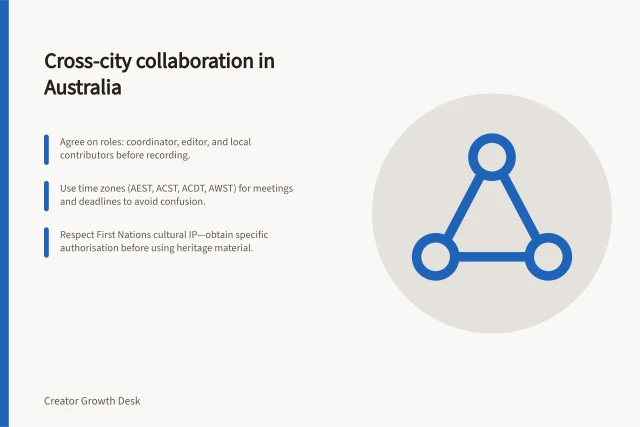
A local contributor can explain a decision, demonstrate a method or review the framing. Agree on what will be shown, credit and reuse. Their participation does not establish that everyone in their community agrees.
Take particular care with First Nations cultural material. Creative Australia’s arts protocols endorse First Nations rights to cultural heritage, self-determination and meaningful collaboration. Seek appropriate permission and consultation for the material and community involved. The protocols are arts-focused, and their funding condition applies to specified Creative Australia projects.
Using Local Contributor Input in Regional Content
- Pros
- Authentic insights, cultural accuracy, community relevance
- Cons
- Risk of overgeneralisation, potential for misrepresentation if not properly consulted
Publish the boundary with the answer
State the checked setting beside the instruction it affects. For example: “This purchasing step uses a service available in the named town; check your local options before following it elsewhere.” That gives a reader a usable limit at the point of decision.
Treat a local correction after release as information to verify. Correct an error in the existing piece first. Make another regional piece when a different place presents a genuinely different decision that needs its own answer.