Audience Building
Part of Turning viewers into returning followers
Giving viewers a reason to follow a continuing series
A continuing series earns a follow when the next instalment promises another answer the same viewer will need.
A continuing series earns a follow when the next instalment promises another answer the same viewer will need. Name the problem the series solves, make each episode useful on its own, and show how the next builds on it. A part number alone is not a reason to return.
Define the series promise
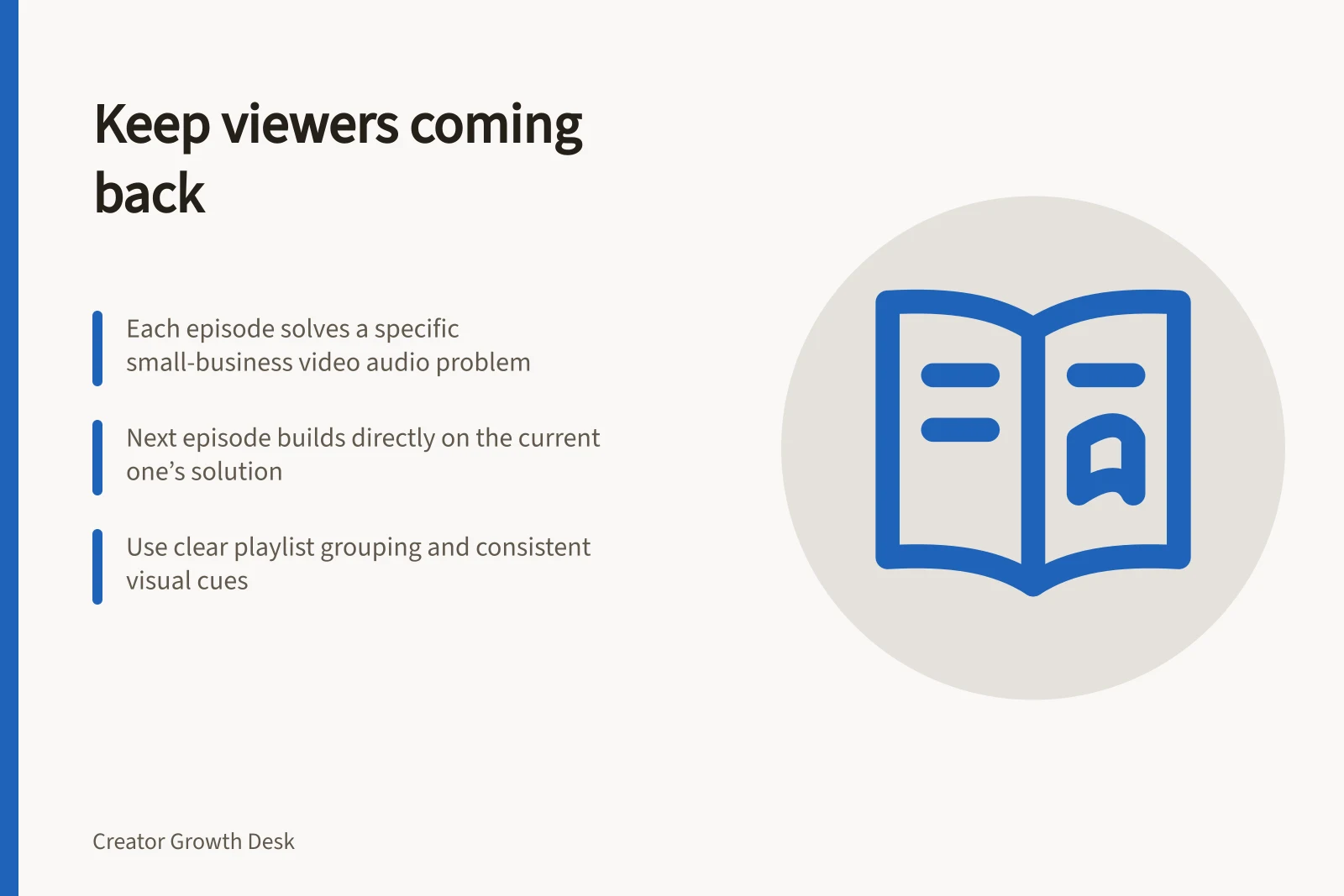
Write one sentence that a viewer could repeat: “Each week, we fix one common mistake in small-business video audio.” That is clearer than “Weekly creator tips”.
The sentence sets a topic boundary and helps the producer reject an episode that does not belong. If the series can only be sustained by repeating a broad idea, narrow it or make it a finite run.
Plan a handful of questions in the order a viewer might encounter them. A creator reviewing home office lighting might cover window placement, mixed light and screen glare.
It helps to build a series around topics that have already interested viewers. Do not assume every one-off how-to viewer will return after getting their answer.
Use that as a planning clue, not a promise of growth. Inspect comments and search questions for genuine follow-on needs rather than inventing a cliffhanger.
How to build a compelling continuing series on YouTube
- Define a clear, specific promisee.g., 'Each week, we fix one common mistake in small-business video audio.'
- Plan episodes around real viewer questionsUse comments and search queries to identify follow-on needs, not invented cliffhangers.
- Ensure each episode stands aloneMake every instalment useful even if viewers miss earlier ones.
- Signal the next episode clearlyState the next topic and why it follows: e.g., 'Now that the microphone is placed, next week we’ll tackle room echo.'
- Organise content in a playlistUse YouTube’s series grouping or playlist feature for easy navigation.
Make the next episode concrete
At the end of an instalment, state the next question and why it follows: “Now that the microphone is placed, the next video will deal with room echo.” If the next episode is not ready, avoid a precise publication date. Put the finished episodes in a clear playlist or series grouping where the platform supports it.
Use consistent visual cues sparingly. A familiar title prefix and thumbnail treatment can signal the series, but the topic itself should remain legible. Do not bury the specific answer under identical episode names.
Before publishing a new episode: Series promise checklist
- Is the next episode’s topic clearly stated?Yes / No
- Does the next episode logically follow from this one?Yes / No
- Are finished episodes grouped in a playlist?Yes / No
- Is the thumbnail and title still focused on the specific topic?Yes / No
Check whether the promise is working
For detailed guidance on measuring whether a format brings viewers back, see the sibling article.
Key stats for measuring series success (via YouTube Analytics)
- Audience retention rate per episode
- Measure drop-off points to assess engagement depth.
- Repeat viewership (returning viewers)
- Track how many viewers return across multiple episodes.
- Playlist completion rate
- Percentage of viewers who watch all episodes in a series.
- Subscriber growth from series content
- Monitor increases linked to series episodes.