Content Ideas
Part of Growing through searchable creator content
Naming videos around questions viewers actually ask
Turn a viewer’s question into an accurate video title, check its scope and distinguish it from nearby answers.
Name a searchable video for the question it answers, using words a viewer would recognise and a scope the video can keep. You do not need to copy a search query exactly. A newcomer should understand the promised answer before clicking.
Identify the task in the video
Start with the finished video or a precise outline. Write its answer in one sentence, then list ways someone facing that task might ask for help. “Why does my voice sound hollow?” and “How do I reduce echo in a home recording?” may point to related problems, but the video must establish which one it addresses.
Your YouTube video Reach report can show search terms that led viewers to an existing video. Studio’s Trends tab can suggest searches and content gaps for Shorts. Some insights depend on country, language or device. Neither report tells you what every viewer means by a phrase; check the demonstration before choosing the wording.
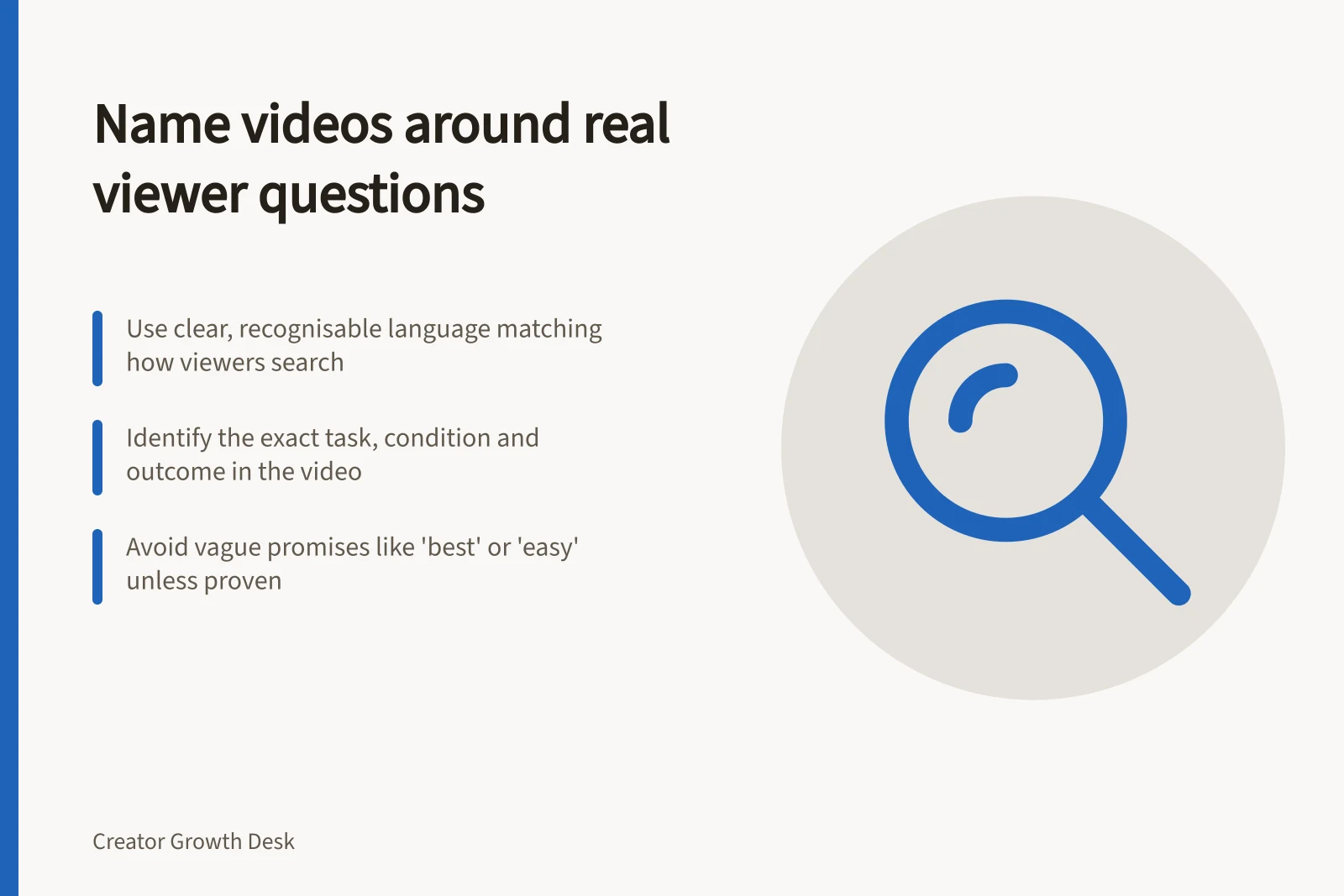
Use three questions to draft the title:
Check / Ask
- Task
- What is the viewer trying to do or decide?
- Condition
- What device, version or setting changes the answer?
- Outcome
- What can the video genuinely help them complete or understand?
Include an essential condition in the title where it fits. Otherwise, state it clearly in the opening and description.
How to create a question-based video title
- Define the taskWrite one sentence describing what the video helps viewers do (e.g., ‘Reduce echo in a home voice recording’).
- Identify common phrasingsList how someone might search for help (e.g., ‘Why does my voice sound hollow?’ or ‘How to stop echo in recordings?’).
- Check existing performance dataUse YouTube Analytics’ Reach report and Trends tab to see real search terms driving traffic.
- Draft the title using the three questionsTask: What are they trying to do? Condition: What device/version matters? Outcome: What will they achieve?
- Review for accuracy and clarityEnsure the title matches the video’s opening and actual content; avoid misleading promises.
Write a promise the video keeps
Put the recognisable task near the front. “Reduce echo in a home voice recording” gives a stranger a clearer choice than “Studio diary 04: the sound fix”. YouTube advises accurate, succinct titles with important words early because viewers may see only part of a title. An episode number can come later.
A question title works when the video answers that question directly. A how-to title works when it demonstrates the method. Avoid “best”, “easy” or a universal result unless the video supports that claim. Do not promise a complete setup when the recording shows one isolated tip.
Read the title alongside the opening and the result. If the answer begins after a long unrelated introduction, improve the video. If the title describes a different problem, choose the task the recording actually solves.
Distinguish nearby answers
Give similar videos different jobs. “Check room echo before buying a microphone” and “Position a microphone for a spoken lesson” can coexist if the recordings cover those separate decisions. Two titles promising the same fix make it harder to choose between them.
Scan your existing videos before publishing. Improve a current, complete answer when it already serves the question. Make another video when a different condition or changed process needs a genuinely different demonstration.
After release, compare available search terms with the intended task. If people appear to arrive for another question, inspect the title, description and video together. YouTube says a title change may affect how viewers respond to a video; the edit itself is not an automatic ranking boost.
Title types: What works and what doesn’t
- Effective title
- Reduce echo in a home voice recording using a USB mic
- Ambiguous title
- How to fix voice quality
- Clear with context
- Fix echo in Zoom calls on Windows with OBS Studio