Audience Building
Part of Content positioning for independent creators
Turning expertise into a clear audience promise
Translate what you know into a specific, credible promise about the help your creator content will provide.
An audience promise states what people can expect to learn, do or decide from your work. “I know garment repair” describes the creator. “I explain how to assess and make simple clothing repairs with a basic kit” describes the help. Write a promise that fits your knowledge, the work you can produce and the limits of your advice.
Find the help within your expertise
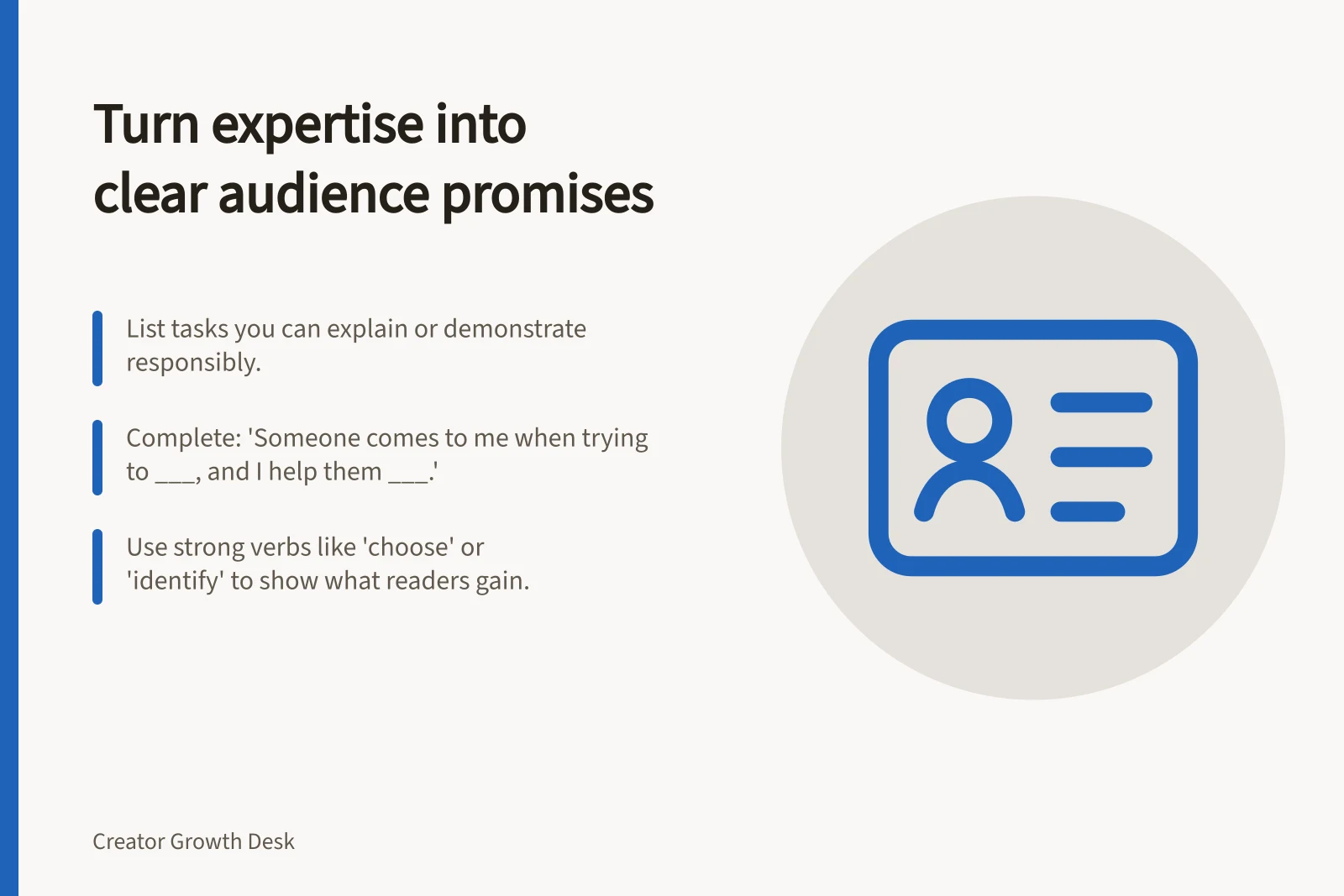
List the tasks you can explain or demonstrate responsibly. Include decisions where your judgement matters: choosing a method, spotting a poor fit or recognising when specialist help is needed. Credentials may support your advice, but first identify what a reader can gain from it.
For each task, complete this sentence: “Someone comes to me when they are trying to ___, and I can help them ___.” Replace vague endings such as “learn more” with a useful action. Could they compare options, try a first step or recognise a condition that changes the answer?
Keep the outcome within your control. “Make every garment look new” promises more than a repair guide can deliver. “Learn which everyday repairs are worth attempting at home” lets you explain the exceptions.
Draft the promise from the reader’s side
Bring together the person or situation, the outcome and your method. For example: “For people mending everyday clothes with a basic kit, I show how to assess the damage and choose a suitable fix.” You can shorten this for a profile, provided the meaning stays clear in the work around it.
Check the verbs. “Share” and “talk about” describe what you do; “identify”, “choose” and “make” can describe what the reader gains. Use the stronger verb only when your content gives someone enough information to act on it.
For subjects that change quickly, promise a type of help rather than permanent currency. A software creator could offer walkthroughs for specific tasks, naming the version and relevant limits in each piece. “Always up to date” would be a harder promise to keep.
Key Principles for a Credible Audience Promise
- Focus on reader outcomesUse verbs like 'identify', 'choose', 'make' to show what the reader can do.
- Limit scope to what you can deliverAvoid overpromising; e.g., 'Learn which repairs are worth doing at home' vs. 'Fix any garment'.
- Use Australian English conventionsSpelling: colour, organise, practice, program. Terms: GST, ABN, ATO, superannuation where relevant.
- Keep credibility through consistencyEach piece should align with the promise—no surprise content.
Check what the promise commits you to
Write three distinct piece ideas. For the repair example, one might cover assessing a loose seam, another choosing a hand stitch and a third recognising fabric too worn for a simple mend. Each should deliver a useful answer on its own while fitting the same promise.
Read the promise beside a draft. Does the piece provide the help a newcomer would expect? Is the expertise visible in the explanation or demonstration? If the draft only asserts your experience, add the reasoning that makes it useful, or narrow the promise.
Feedback can reveal confusing wording, but a few comments cannot establish what every potential reader wants. Refine the sentence when it misleads; keep its underlying commitment aligned with the work you plan to publish.