Audience Building
Part of Community habits that support creator growth
Choosing questions that lead to real audience replies
Choose audience questions that invite specific experiences, constraints and useful follow-up instead of empty engagement.
Ask for a specific contribution someone can make after consuming the piece: a choice they face, a condition you did not cover or a step they found difficult. Connect the question to the answer you gave. A prompt can invite conversation; it cannot make people want one.
Choose the job of the question
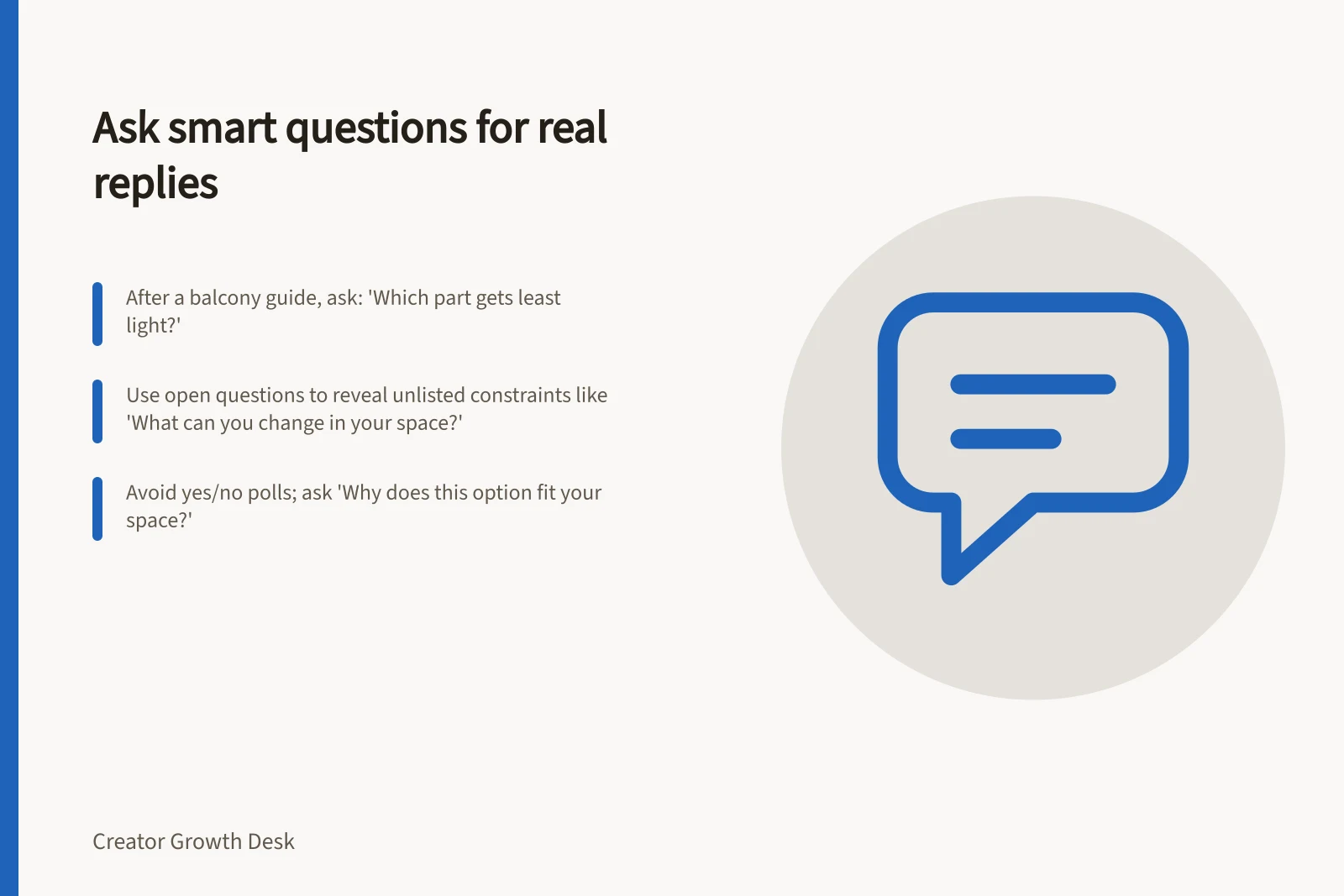
Start by naming what the piece helps someone do or decide. Then identify what a reply could usefully add. After a balcony-growing guide, “Which part of your balcony gets the least light?” asks about a condition that may change how someone uses the advice. “Thoughts?” leaves viewers to invent the subject.
Choose one purpose for the prompt:
Purpose / Example question
- Find a condition the example missed
- “Which part of your setup differs from this one?”
- Locate an unclear step
- “At which step would another demonstration help?”
- Compare approaches
- “Which option fits your space, and why?”
These are writing examples, not tested prompts. Ask only for details needed to discuss the topic, and give people enough context to answer.
Effective vs. Ineffective Audience Questions
- Effective Question
- Which part of your balcony gets the least light?
- Ineffective Question
- Thoughts?
How to Craft a Purposeful Audience Prompt
- Identify the job of the piecee.g., guide on balcony gardening
- Determine what reply adds valuee.g., unique space constraints
- Choose one purpose: condition, step clarity, or comparisone.g., 'Which option fits your space, and why?'
- Frame the question with context and opennesse.g., 'What can you change in the space you already have?'
Make it easy to answer honestly
A narrow starting point usually asks less work of a viewer than a request for their whole story. Leave room for answers you did not anticipate. “Would you buy a planter or a shelf?” excludes someone who can use neither. “What can you change in the space you already have?” allows a different constraint to surface.
Avoid questions that prescribe praise or agreement. If you need to know whether a step was clear, ask about that step. A fixed-choice poll can show which listed option people select, but it cannot explain their reasons or capture every unlisted option.
Use an open reply when the reason matters.
Place and interpret the prompt
Ask after delivering the main answer, when people know what they are responding to. A short closing question may be enough. If you use a comment to restate a more detailed situation, keep any essential instruction in the piece itself rather than relying on readers to find it there.
If a reply needs clarification, ask for the missing condition without diagnosing a personal situation from one sentence. If replies reveal an error in the piece, correct the piece before treating the conversation as a reason for a new one.
Judge replies by what they reveal: useful constraints, clear questions and reasons for disagreement. Few replies may still help; many brief replies may tell you little. Visible commenters are only part of the audience, so keep that limit attached to what you learn.