Content Ideas
Part of Finding content ideas from audience questions
Turning recurring comments into useful content
Group repeated comments by the decision behind them, choose a suitable answer and avoid making duplicate or misleading content.
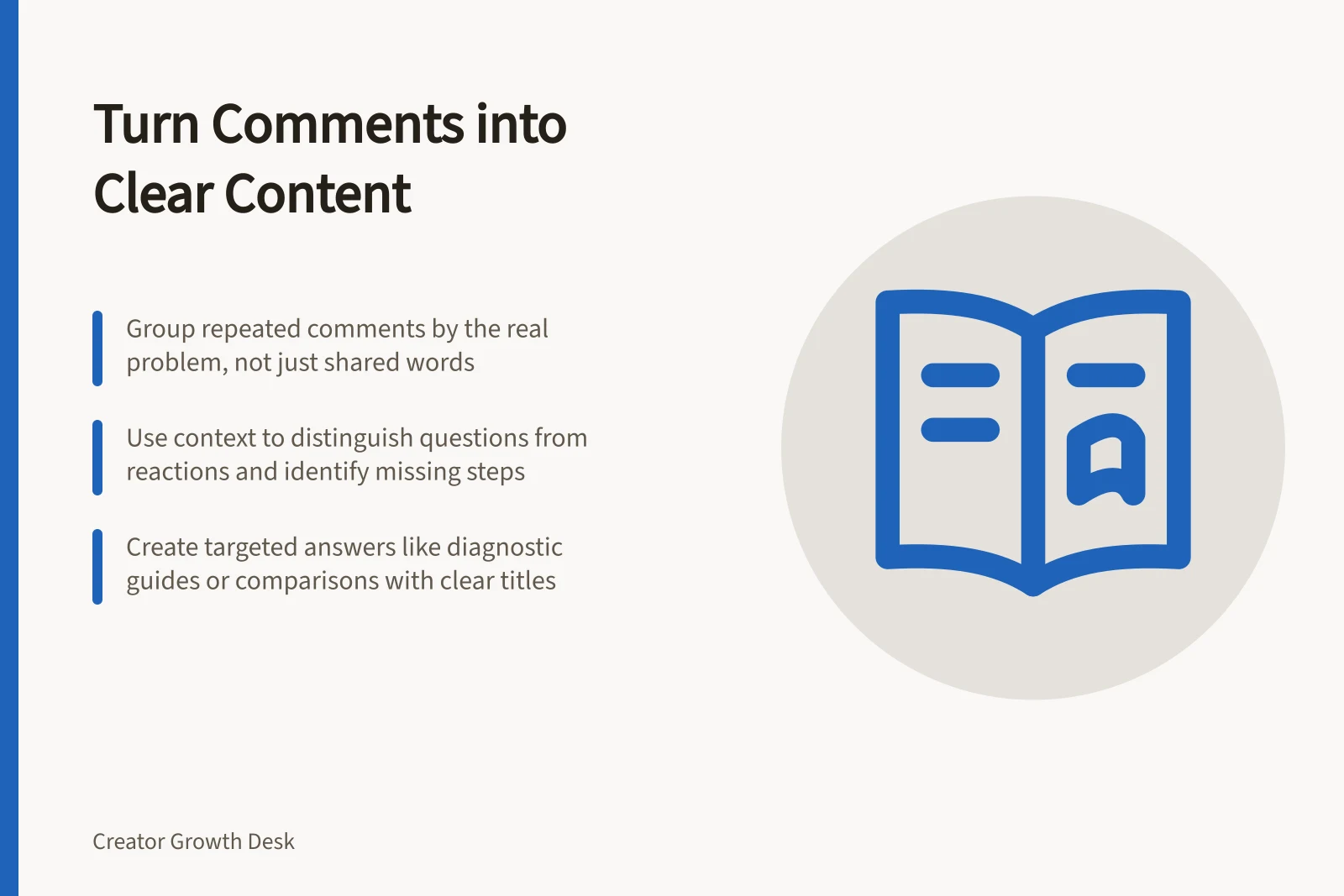
When several comments seem to ask the same thing, group them by the problem behind their wording. Then make one piece that answers that problem completely. Recurrence earns an idea a closer look; it does not prove that every viewer is confused or that the most frequent request should become your next post.
Read the comments in context
Start with comments on pieces that address the same task. Note the original topic, the point in the piece that prompted the reply and what each commenter appears to be trying to do. “Which microphone?” under a first recording guide may ask for a product choice. Under a video about unclear speech, it may ask how to diagnose a poor recording.
Separate questions from reactions. “This is hard” signals friction, but it does not identify the missing step. A reply such as “Which part was difficult: setting the level or checking the recording?” may reveal a question worth answering. Avoid identifying or quoting a commenter in a new piece without checking the context and obtaining permission where appropriate.
Where a platform gives you tools to review and reply to comments, use them to read the underlying remarks before deciding what people meant. A manual list can serve the same editorial purpose on another platform.
Key Insights from Comment Analysis
- Recurring comments indicate a gap in content
- Not every repeat request means confusion—some reflect unmet need
- Context matters more than keywords
- Same word ('microphone') can mean different problems based on situation
- Direct replies improve engagement
- Responding to commenters builds trust and reduces future repetition
Cluster by the decision, not a shared word
A small working table can keep unlike requests apart:
Record / Hypothetical entry
- Reader situation
- Recording spoken lessons at home
- Stated question
- “Do I need another microphone?”
- Possible underlying decision
- What to check before replacing equipment
- Important variation
- Some mention echo; others mention low volume
- Existing answer
- A setup guide covers placement but not diagnosis
Echo and low volume may need different explanations even when both commenters use the word “microphone”. If the conditions change the answer, create separate pieces or a comparison that makes those conditions clear. If a current piece already answers the question, make it easier to find or clarify the passage instead of publishing a near duplicate.
Choose an answer that fits
A recurring clarification can become a short demonstration when one action solves the problem. A repeated choice between methods may need a comparison. A question with several possible causes may need a diagnostic guide that starts with what to check and explains when each next step applies.
Make the title name the decision. “What to check when a home recording sounds distant” is more useful than “You asked, we answered”. Open with the answer, then show the example or steps that make it usable.
Include any limitation people need before trying it. If comments reveal that an earlier piece was misleading, correct that piece too.
Do not turn one thread into a supposedly universal FAQ. Check whether the same problem appears under other relevant pieces or in conversations. A single thoughtful question may still justify content when its answer matters and is within your expertise.
Reply and review
Where practical, answer the original commenters directly. Do not make someone wait for a new post to receive a simple answer you can give now. In the new piece, describe the problem without presenting identifiable details as a public case study.
After publication, look at the next questions. If people still ask the original one, check whether the title, opening or example made the answer clear. A question about a different condition may deserve a follow-up. Comments come from people who chose to speak, so keep that limit attached to what you learn from them.