Audience Building
Part of Diagnosing a creator growth plateau
Deciding whether to refine a niche or expand it
Choose whether to clarify an established creator niche or test an adjacent need using the fit of recent work and its audience response.
Refine an established niche when people still need your core help but your topics or examples make that help hard to recognise. Test expansion when the same people have a clear adjacent task that the current boundary excludes. A growth plateau alone supports neither choice; first check what changed and whether exposure has another plausible explanation.
Start with the continuing task
Write down the task your existing work helps people complete. Then sort recent pieces into three groups: those that serve it, those that serve a nearby task for the same people, and those that appear to serve another audience. This reviews an established body of work, not a method for choosing a first niche.
For each group, ask whether the intended people could find the work, whether it delivered its stated answer and whether it led to another relevant question. Comments may reveal particular needs while representing only those who chose to comment.
Match the change to the pattern
| Pattern to investigate | Editorial move | Reason |
|---|---|---|
| Related pieces serve one task, but titles and examples suggest different audiences | Refine the promise and examples | Make existing help easier for its intended viewer to recognise. |
| Core work repeatedly raises an adjacent task for the same people | Try a bounded expansion | Cover a next need without promising an unrelated subject. |
| A broad one-off piece gains attention but later core work shows little related interest | Keep it as a one-off while investigating | Reach alone does not justify changing the whole promise. |
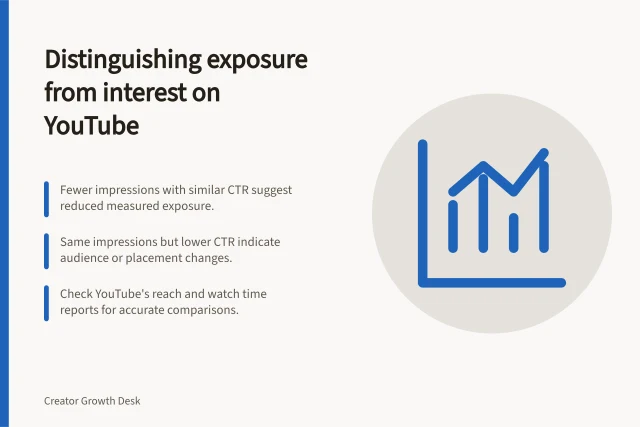
| Exposure falls across otherwise useful core work | Investigate exposure first | A fall in exposure may have explanations beyond the editorial boundary. |
These are editorial choices, not measured growth rules.
For example, a creator helping teachers record clear spoken lessons at home might refine the focus if recent work jumps among classroom technology, music production and voice recording without making its intended audience clear. Explaining how to check whether a recorded lesson is understandable could be an adjacent task for the same teachers. These are hypothetical possibilities, not findings about an audience.
Match the change to the pattern
- Related pieces serve one task, but titles and examples suggest different audiencesRefine the promise and examples — make existing help easier for its intended viewer to recognise.
- Core work repeatedly raises an adjacent task for the same peopleTry a bounded expansion — cover a next need without promising an unrelated subject.
- A broad one-off piece gains attention but later core work shows little related interestKeep it as a one-off while investigating — reach alone does not justify changing the whole promise.
- Exposure falls across otherwise useful core workInvestigate exposure first — a fall in exposure may have explanations beyond the editorial boundary.
Try one boundary change
For a refinement, keep the underlying subject and make the audience situation clearer in each piece. For an expansion, choose one adjacent question, show its connection to the core and deliver the same standard of help. Keep the current body of work available while you learn from the new pieces.
Before the run, write down what would support continuing: relevant follow-up questions, interest in another related piece, or evidence that the answer helps the same people. Also note what would challenge it, such as repeated requests for an unrelated subject or an answer you cannot give credibly.
Compare pieces of similar format and time live where possible. A small run cannot prove the future size of a niche.
End with a plain decision: refine the current promise, add a named adjacent task, or gather more evidence. State which pieces and responses informed it. The boundary should help someone understand who your next work serves and why it belongs.
Before testing a boundary change
- Write down what would support continuingRelevant follow-up questions; interest in another related piece; evidence that the answer helps the same people.
- Note what would challenge itRepeated requests for an unrelated subject; an answer you cannot give credibly.
- Keep the current body of work availableLearn from the new pieces without removing existing help.
- Compare like with likePieces of similar format and time live where possible.
- Accept the limits of a small runA small run cannot prove the future size of a niche.
Choose a boundary change
- Start with the continuing taskWrite down the task your existing work helps people complete.
- Sort recent piecesServe it; serve a nearby task for the same people; appear to serve another audience.
- Check the responseCould intended people find it? Did it deliver its stated answer? Did it lead to another relevant question?
- Match the patternRefine the promise, try a bounded expansion, keep a one-off, or investigate exposure first.
- Run one boundary changeRefinement: keep the subject, clarify the audience situation. Expansion: choose one adjacent question and connect it to the core.
- Decide plainlyRefine the current promise, add a named adjacent task, or gather more evidence—and state which pieces and responses informed it.