Retention
Part of Diagnosing a creator growth plateau
Finding topics that attract followers but not returning viewers
Compare subscriber entry topics with later content and returning-viewer signals without mistaking aggregate reports for individual tracking.
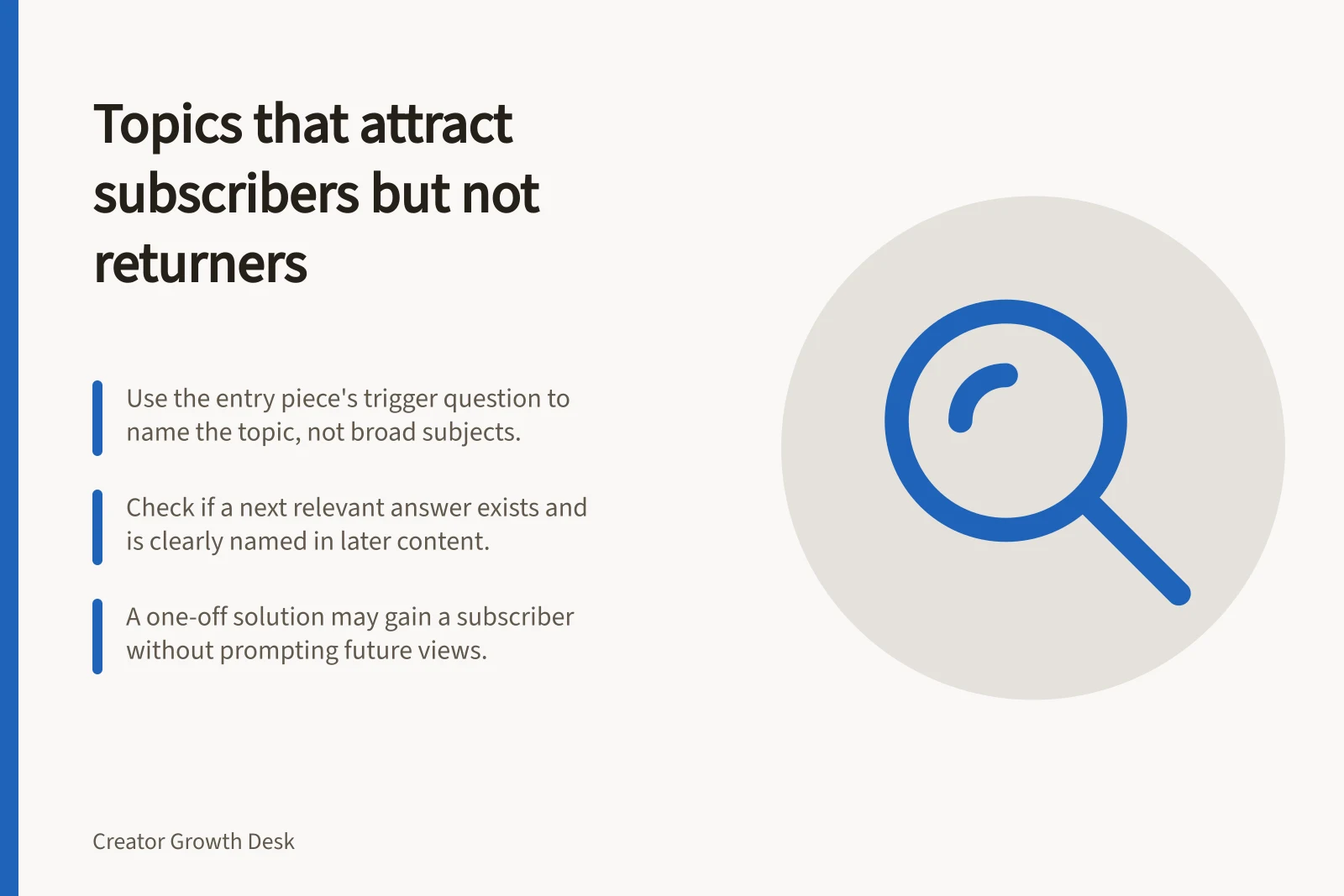
Find topics that gain subscribers by identifying the question a person likely came to answer, then matching it with related work published afterwards. Name the topic by that task and compare the later work’s visible response: a useful one-off answer may earn a subscription without giving a reason to watch the next piece. This diagnoses topic-and-promise fit, not an individual subscriber’s later viewing.
Identify the entry topics
List pieces linked to subscriber gains and name the task each served. YouTube Analytics has a subscription-source dimension showing where people clicked Subscribe, but a click location does not reveal a person’s motive or later viewing.
Write the question each entry piece answers, then group individual pieces by the need they serve rather than a broad subject label. Compare individual pieces in Advanced Mode where the reports allow it.
A hypothetical guide to choosing a microphone for home lessons and one about removing echo from home lessons may serve the same teacher; a celebrity-microphone clip may serve another interest. Use the actual content and response to test that distinction rather than assume it.
Check the next relevant answer
For each entry piece, write the question a newcomer might reasonably expect the account to answer. Inspect subsequent pieces that could serve the same person: look for a plausible next answer suited to the same level and setting, and check whether it was available and clearly named. Record what you find and what is missing; a one-time search question may end with the first answer, which is not a failure of the piece.
Record / Question
- Entry piece
- What exact problem did it solve?
- Likely expectation
- What related help could this viewer want?
- Next relevant piece
- Was that help available and recognisable?
- Visible response
- Did later related work attract returning viewers or relevant questions?
- Other differences
- Did timing, promotion, topic or format also change?
If related work exists but shows weak visible interest, name the entry topic by its trigger question and note which later pieces you checked. Do not infer that subscribers gained from that topic did or did not watch them: a channel-level returning-viewer measure cannot establish that.
Read return measures at the right pace
YouTube Analytics’ Audience > New & Returning Viewers report presents new, casual and regular viewer categories. A recent topic cannot be judged by the regular-viewer category after a few weeks, and subscriber count differs from the number of active viewers. Look first at interest in a relevant follow-up, then review broader return behaviour over time.
Weak visible interest can have several explanations: the first answer may have completed a one-time task, the follow-up may have been hard to recognise, or the entry topic may have drawn people outside your continuing subject. Read the pieces and relevant questions before choosing an explanation. Comments represent only viewers who chose to comment.
YouTube Analytics: Audience Segments Overview
- New Viewers
- First-time visitors to your channel
- Casual Viewers
- Viewers who return occasionally but not consistently
- Regular Viewers
- Audience segment with consistent re-engagement over time
- Subscriber Count
- Total number of people who clicked Subscribe
Decide what the topic deserves
If the entry topic serves your core audience, answer a genuine next question and make the relationship clear. If it serves a different audience you do not intend to keep helping, leave the useful one-off piece in place without rebuilding your programme around it. If adjacent topics repeatedly bring interest in later core work, consider whether that adjacent need belongs in your continuing promise.
Record the trigger question, the hypothesis and the later pieces checked, then compare those pieces after similar time live. A subscriber gain records an action at one moment; continued interest needs separate evidence.
![Check if packaging reaches your intended audience: This piece is for [person in a situation] who needs [decision] and delivers [answer].; Compare the routes into the video before interpreting a rate.; If the title or image suggests the wrong task, make that element more exact. Checking whether packaging attracts the intended audience](/covers/checking-whether-packaging-attracts-the-intended-audience-640.webp?v=114adaa3)