Audience Building
Growing through searchable creator content
Build a searchable video library by answering specific questions, making each answer clear and keeping tutorials accurate.
Searchable content can introduce your work to someone seeking an answer. Pick a specific question, answer it fully and make the answer easy to recognise; keep it accurate. Search visibility does not guarantee a view, a follow or a return visit.
YouTube says its search system considers relevance, engagement and quality. Relevance covers how the title, description and video content match a query; matching words alone do not secure a position.
Interpret search signals carefully
YouTube says engagement can include a video’s watch time for a particular query, helping it estimate whether other viewers found the video relevant to that search. Its quality signals aim to identify channels showing expertise, authoritativeness and trustworthiness on a topic.
Organic search placement cannot be bought. Results can also differ between viewers because YouTube may consider their search and watch history when it is turned on.
YouTube search signals: What drives visibility
- Relevance
- Matches between query and title/description/video content
- Engagement
- Watch time for users searching that term
- Quality Signals
- Expertise, authoritativeness, trustworthiness (EAT) on the topic
Choose a question you can answer
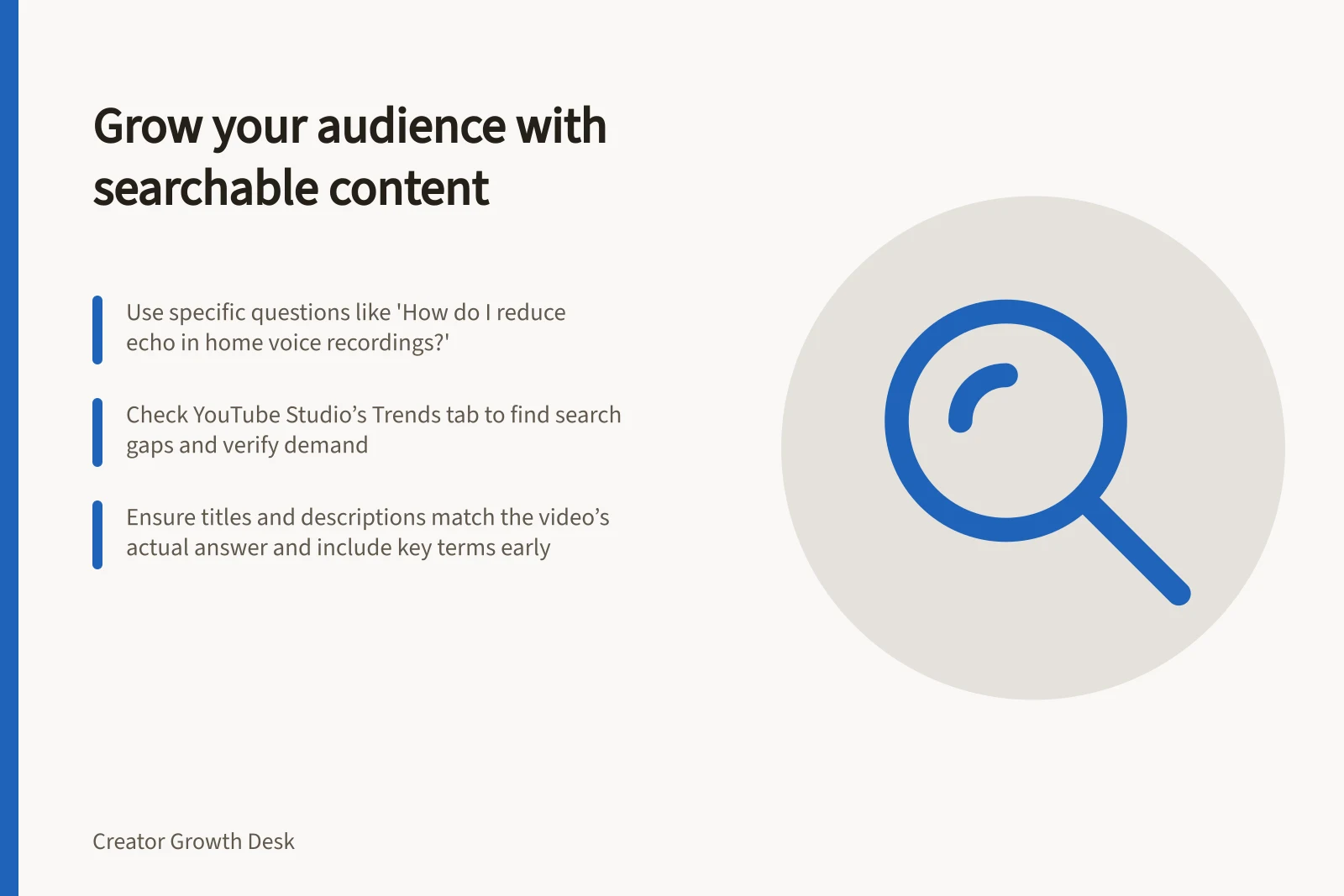
Name a task someone could describe without knowing your channel. “How do I reduce echo in a spoken lesson recorded at home?” is a clearer job than “better audio”.
Decide what the viewer should be able to do after watching and which conditions change the answer. If the method depends on a device or software version, check that boundary before filming.
Comments and your own search reports may reveal wording worth investigating. YouTube Studio’s Trends tab can suggest searches and content gaps for Shorts, though some insights are limited by country, language or device; the Studio update is rolling out gradually.
A visible gap is a prompt to investigate, not proof your video will find an audience. Check whether a current video already answers the question before making another.
Use Trends to check the question
In YouTube Studio, open Analytics, select the Trends tab and enter a search topic. Top searches reflect your audience and saved searches over the last 28 days, helping you check whether the wording you plan to answer is being searched.
For Shorts, the Content gaps card identifies searches where viewers may be unable to find results, an exact match or relevant videos. A gap may point to old or low-quality results, not just an absence of videos. Treat it as a reason to assess existing answers, not a guarantee of demand for yours.
Make the answer work on its own
A search visitor may meet your fourth video first. State the problem early, show the necessary steps and explain the conditions that change the result. Do not withhold a step for another instalment; related videos can extend a complete answer.
Watch the finished piece against its proposed question. If it covers only one small part of a broad promise, narrow the title; if it covers several decisions, give viewers a clear route through them. The question, title and demonstration should agree.
How to create searchable creator content that ranks on YouTube
- Identify a specific, answerable questione.g., 'How do I reduce echo in a spoken lesson recorded at home?'
- Use YouTube Studio’s Trends tab to validate search demandCheck if the topic is being searched over the last 28 days; look for content gaps in Shorts
- Structure the video to deliver value independentlyState the problem early, show all steps clearly, and avoid withholding key info for later videos
- Optimise title and description for search visibilityPlace key task terms first (e.g., 'Reduce echo in a home voice recording'); include prerequisites and next steps
- Group related videos into playlists with clear navigationEach video should solve one distinct question; use playlists to guide viewers through a journey
- Maintain accuracy and update metadata as neededIf software or settings change, trim the video or edit metadata instead of re-uploading; mark updates visibly
- Review Reach reports to assess search performanceUse YouTube Studio’s ‘How viewers find this video’ report to see actual search terms used; compare them to your intended focus
Help the right viewer recognise it
Name the task near the start of the title. “Reduce echo in a home voice recording” tells a newcomer more than “My audio setup, part four”. YouTube advises accurate, succinct titles with important words early; an episode number can follow the specific answer.
Use the first lines of the description to explain the task and any crucial limit. Add prerequisites and a relevant next answer where they help, and give each video a distinct description as YouTube recommends. Neither field can repair a video that fails to deliver its promise.
Pre-upload checklist for searchable YouTube videos
- Is the core task named early in the title?Yes / No
- Does the first sentence of the description explain the task and key limits?Yes / No
- Are prerequisites clearly listed?Yes / No
- Is there a distinct description for each video?Yes / No
- Has the video been reviewed against its intended search query?Yes / No
Connect distinct answers
Group videos when they serve successive decisions for the same person. A home-recording collection might cover room choice, microphone placement and checking a test recording.
Name each video for its own question, then use a playlist to show the wider route. An ordinary YouTube playlist supports a title, description and chosen order.
Keep the route clear for someone who needs only one answer. If two videos promise essentially the same fix, clarify the difference or improve the stronger answer before adding another.
Keep instructions accurate
Record the version or condition a tutorial depends on. When a step changes, make the video’s status visible to people who may still find it through search.
Choose a maintenance edit
You cannot replace an uploaded video with a new file. You can modify the existing video: YouTube supports trimming the beginning, middle or end, plus changing its title, category, description and privacy settings.
Consider whether a trim or metadata correction is enough before deciding the demonstration needs a new upload. A new upload receives a new URL.
Review what search visitors found
For each video, record its intended question, scope and a trigger for checking it again. YouTube’s video Reach report can separate YouTube Search from other traffic and show some search terms viewers used.
Compare those terms with the task the video solves. Total views alone do not show search growth.
If search visitors appear to be looking for another answer, inspect the title, description and video together. If viewers leave before a necessary step, watch that passage before proposing an edit. These are editorial checks, not evidence that a change will improve ranking.
Check the search terms in Reach
To inspect a video, open YouTube Studio, choose Content, select the video, then open Analytics and Reach. The “How viewers find this video” report shows traffic-source types; the YouTube search report lists terms viewers searched when they found the video.
Some Reach reports may not be available on mobile. If you cannot see a report there, check it in Studio on a computer before drawing conclusions about the video’s search traffic.
In this guide
- Naming videos around questions viewers actually askTurn a viewer’s question into an accurate video title, check its scope and distinguish it from nearby answers.
- Writing descriptions that help viewers choose the right videoWrite video descriptions that state the task and limits early, then help viewers navigate the answer.
- Grouping searchable content into a clear seriesOrganise searchable videos into a useful series with complete answers, clear titles and a sensible viewing route.
- Updating an old tutorial after its instructions changeCheck what changed, choose a clear correction or replacement, and show viewers which tutorial still applies.