Publishing Rhythm
Part of Creator collaborations for audience growth
Comparing guest appearances with joint content series
Choose between a creator guest appearance and a joint series by comparing viewer value, production commitment and distinct follow-up questions.
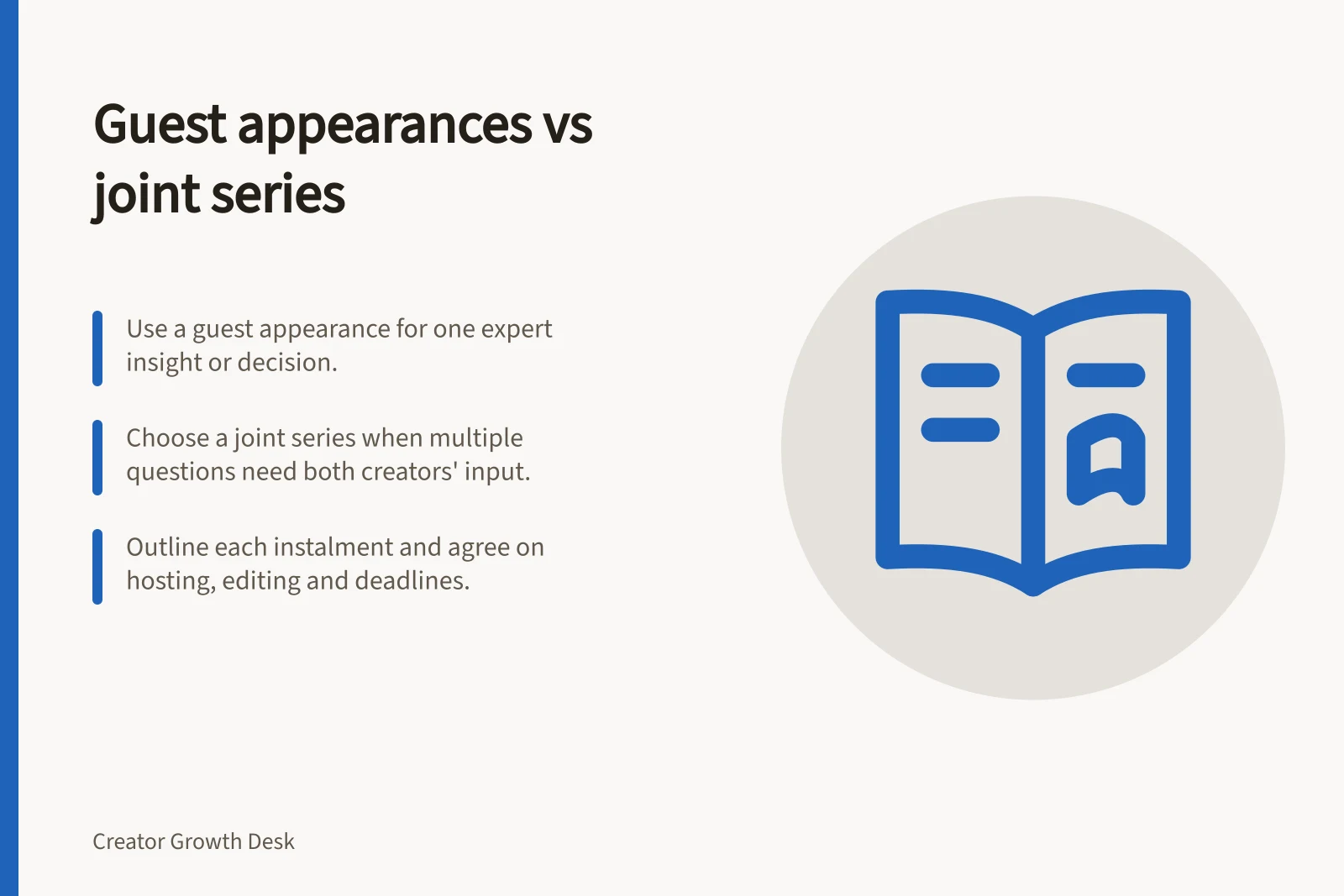
Use a guest appearance when one focused contribution can complete the viewer’s answer. Choose a joint series when the subject contains several distinct questions, both creators can commit to the work and later instalments will remain useful. A series creates more room to develop an idea, along with more promises to fulfil.
| Decision | Guest appearance | Joint content series |
|---|---|---|
| Best fit | One question benefits from a guest’s skill or perspective | Several related questions need both creators |
| Main commitment | Prepare, record, review and publish one piece | Agree on the arc, schedule, ownership and review of each piece |
| Viewer risk | The guest feels incidental | Later parts repeat the first or require viewers to watch in order |
| Useful next action | Point to a relevant piece from each creator | Make every instalment understandable on its own and identify the next question |
These are planning trade-offs, not measured performance differences. Neither format guarantees more followers.
When one guest appearance is enough
A single appearance suits an expert demonstration, a second opinion or a discussion of one decision. The host can establish the audience question, the guest can supply missing knowledge and the ending can direct interested viewers to a relevant follow-up.
Give the guest a role that changes the answer. If the host could remove their contribution without changing the piece, reconsider the idea before recording. A one-off also gives both creators a contained way to learn how they work together.
When a series earns its length
A series makes sense when the audience faces a sequence of different decisions. For example, a home-studio creator and an audio engineer could cover room choice, microphone placement and noise control. Each instalment should solve its own problem; someone who starts with noise control should not need a long recap of the other two.
Before committing, outline each instalment and identify what both creators contribute to it. Decide who hosts each release, who owns the edit, what happens if one part is delayed and whether the series has a defined end.
Decide before promising a schedule
Draft the first title and the next possible questions. Before announcing dates, map each instalment to a date both creators can confirm.
Agree how you will update viewers if one instalment slips. Check each instalment against its own question before recording it.