
Retention
Comparing repeat viewers with one-time reach
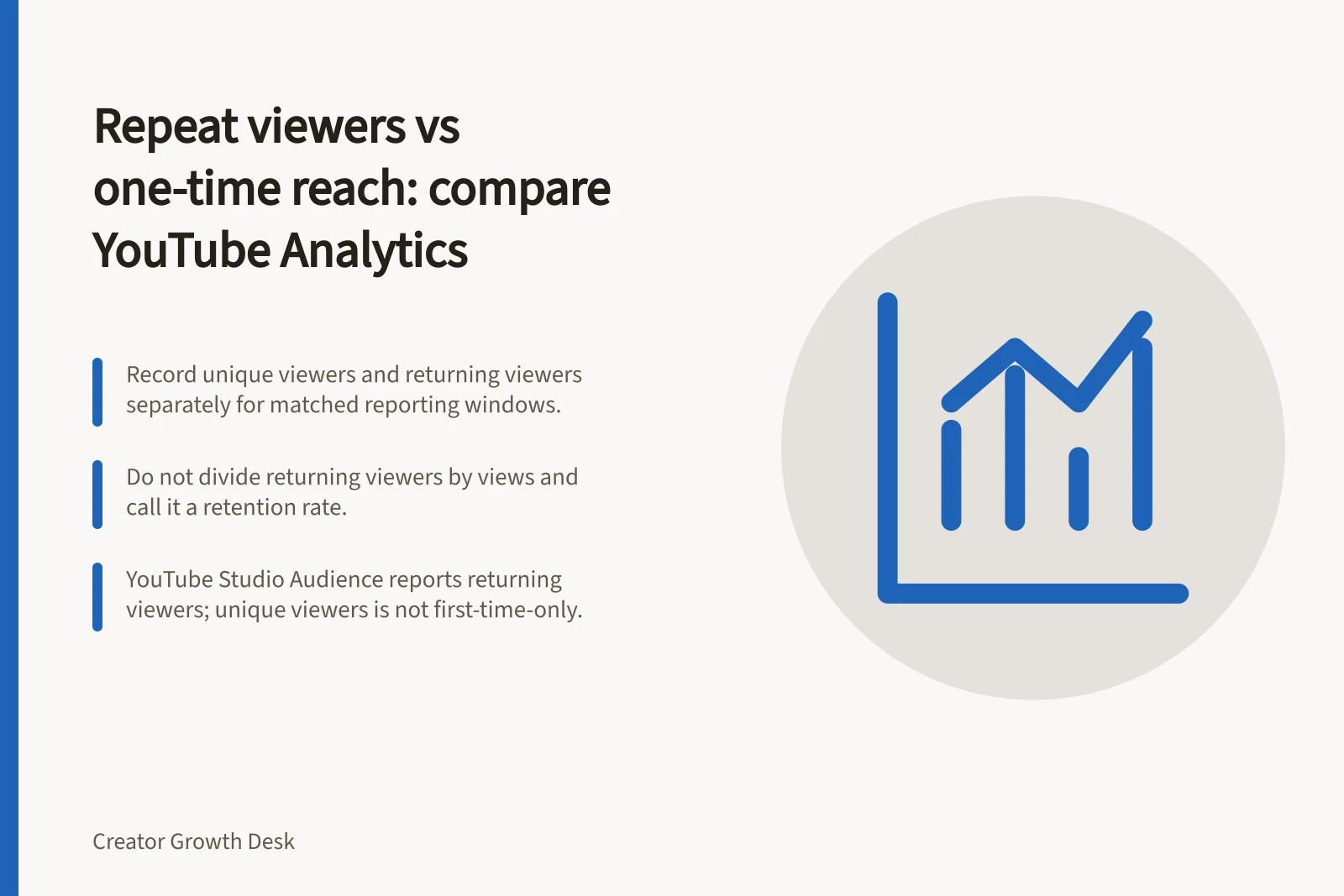
Compare reach, first-time viewing and return with consistent reporting windows, without treating views or subscribers as people.
Compare channel-level discovery with repeat behaviour across matched reporting periods. In YouTube Studio, open Analytics; channel reporting includes Overview, Content, Reach, Engagement, Audience, Revenue and Trends. Audience reporting includes returning viewers.
Use unique viewers to represent distinct viewers in a selected period, and returning viewers to examine repeat behaviour. Treat “one-time reach” as the discovery question, not as a count of first-time viewers: unique viewers is not a first-time-only measure. YouTube Help has pages on understanding your audience and audience retention, so check the current metric definitions there; a useful one-off answer may have little return.
Choose comparable measures and windows
When you compare two periods, use the same measures and reporting windows on both sides. Record unique viewers and returning viewers separately, along with the metric names, reporting window and content published during that window. If you compare two periods, note a collaboration, promotion or unusually broad topic that changed exposure.
Do not divide returning viewers by views and call the result a retention rate. These measures describe different events and may use different populations or windows. Keep Views and watch time separate from viewer counts.
Set up a like-for-like viewer comparison
- Use the same measures on both sidesRecord unique viewers and returning viewers with the same metric names.
- Use the same reporting windowsCompare matched periods so the viewer counts cover equivalent timeframes.
- Record viewer measures separatelyKeep unique viewers and returning viewers as distinct figures.
- Note exposure changesRecord collaborations, promotions or unusually broad topics that changed exposure during the window.
- Keep Views and watch time as contextDo not let Views or watch time replace either viewer measure.
- Do not calculate a retention rate from returning viewers divided by ViewsThese measures describe different events and may use different populations or windows.
Read discovery and return together
For each matched period, record unique viewers and returning viewers as separate measures. Compare each measure with the same measure in the other period; Views and watch time can provide context but do not replace either viewer measure.
| Pattern to investigate | Editorial question |
|---|---|
| Broad reach or many new viewers, with little visible return | Was the answer self-contained, or was a useful related answer missing? |
| Modest discovery, with continuing return | Is existing work serving viewers while newcomers struggle to find it? |
| Growth in both discovery and return | Which topics introduced people, and which later pieces remained relevant? |
| Decline in both | Did output, topic, distribution or audience need change? |
These are questions, not diagnoses. A rise in unique viewers does not establish how many were first-time viewers, and aggregate channel figures cannot show that a particular viewer returned because of one upload. A person may watch without subscribing, or subscribe and stop watching.
These measures cannot give a new series an immediate long-term verdict. YouTube Help has pages on understanding your audience and audience retention, so check that guidance for current definitions and counting rules.
Discovery and return patterns to investigate
- Broad reach or many new viewers, with little visible return
- Was the answer self-contained, or was a useful related answer missing?
- Modest discovery, with continuing return
- Is existing work serving viewers while newcomers struggle to find it?
- Growth in both discovery and return
- Which topics introduced people, and which later pieces remained relevant?
- Decline in both
- Did output, topic, distribution or audience need change?
Decide what the comparison changes
Look at the pieces that introduced viewers and the next answers available to someone with the same need. A search tutorial may solve a complete, one-time question. If the creator promises continuing help, check whether later pieces make that help clear and deliver it.
Record one observation and one next question, alongside unique viewers and returning viewers for the same reporting window. If people arrive for a beginner guide, for example, consider whether the next decision in that process deserves its own complete answer. Review the same measures over a comparable period after publishing. The result may guide the next topic; it cannot prove that one piece turned strangers into loyal viewers.
Turn a viewer comparison into a next editorial decision
- Review introduced viewers and next answersLook at the pieces that introduced viewers and the next answers available to someone with the same need.
- Record one observation and one next questionKeep them alongside unique viewers and returning viewers for the same reporting window.
- Check whether continuing help is clearIf the creator promises continuing help, check that later pieces make the help clear and deliver it.
- Consider a complete answer for the next decisionIf people arrive for a beginner guide, consider whether the next decision in that process deserves its own complete answer.
- Review after publishingReview the same measures over a comparable period after publishing.
![Check if packaging reaches your intended audience: This piece is for [person in a situation] who needs [decision] and delivers [answer].; Compare the routes into the video before interpreting a rate.; If the title or image suggests the wrong task, make that element more exact. Checking whether packaging attracts the intended audience](/covers/checking-whether-packaging-attracts-the-intended-audience-640.webp?v=114adaa3)
